Anarchy
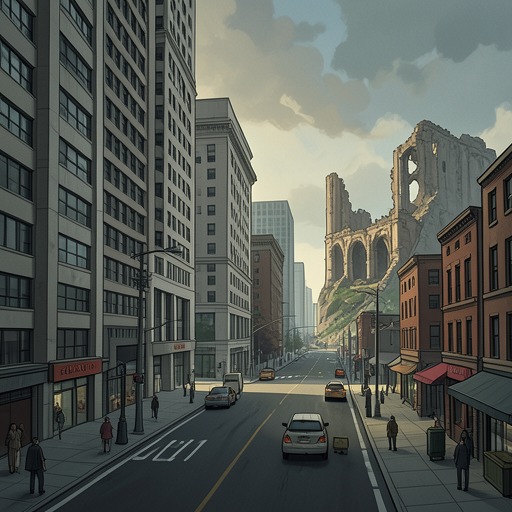
The King in YellowAnarchy denotes the condition of political disintegration that surrounds the United States in the narrator’s account of the future. It is not presented as a local absence of order but as a continental catastrophe: Germany, Italy, Spain, and Belgium writhe under its pressure while Russia watches from the Caucasus and subdues them one after another. Against this spectacle, the United States defines its own calm through centralized authority, controlled borders, military reorganization, and policies that convert social suffering into an administrative problem.
Anarchy as a Geopolitical Threat
The narrator treats Anarchy as the opposite of the national stability that the United States claims to have achieved. The country has benefited from treaties with France and England, restrictions on immigration and naturalization, the settlement of the independent negro state of Suanee, and the gradual concentration of power in the executive. These measures are described as contributing to national calm and prosperity, but the calm is explicitly conditional: self-preservation is called the first law, and the United States looks on in helpless sorrow while European nations are overwhelmed.
Russia’s role gives the condition an imperial and sequential form. Germany, Italy, Spain, and Belgium do not merely suffer isolated unrest; they are imagined as being bound and taken one by one. Anarchy therefore functions both as a social state and as an opportunity for domination, showing how the collapse of political order can make entire nations vulnerable to a stronger power. The image also places the United States in an ethically compromised position: its supposed prudence consists in watching rather than intervening.
Order Built Through Exclusion and Force
The contrast between Anarchy and American prosperity depends on institutions that are themselves coercive. The United States has widened, paved, and illuminated streets, demolished elevated structures, built underground roads, created parks from the stone quays surrounding the island, and erected impressive government buildings and barracks. National Mounted Police make forestry and game preservation easier, while Indian cavalry scouts replace what the narrator calls pitiable military organizations. Public architecture and administrative efficiency thus become visible signs of order, but they stand beside exclusionary citizenship laws, immigration controls, and an increasingly centralized executive.
The same logic governs the Government Lethal Chamber policy. The first chamber opens on April 13, 1920, on the south side of Washington Square, in a garden created after the Government acquired and demolished a block of cafés and restaurants. A white classical building with six Ionic columns, a bronze door, fountains, flowers, and a marble group of The Fates presents state killing as cultivated civic design. The inauguration is protected by United States lancers, police, hussars, state troops, and senior military and medical officials. The spectacle turns exceptional violence into a public ceremony and suggests that the boundary between order and Anarchy is maintained not by abandoning force but by concentrating it in official hands.
Anarchy in the Social and Bodily Imagination
The broader narrative repeatedly associates disorder with bodies that institutions cannot comfortably classify. After his fall from a horse, Hildred Castaigne is carried unconscious from the pavement to Dr. John Archer, who judges his brain affected and confines him in a private asylum for insanity. Though later released, Hildred insists that his mind was always as sound as the doctor’s. The episode reveals how quickly perceived abnormality can be transformed into institutional control: a medical judgment places a person outside ordinary liberty, while recovery does not erase the authority of the earlier diagnosis.
Mr. Wilde offers a different but related image of social dislocation. He is very small, has no ears, wears wax artificial ears supported by silver wires, and possesses a completely fingerless left hand, yet his arms and thighs are powerfully developed. His unusual body contributes to the impression that he is monstrous or insane, although Hildred regards him as extraordinarily intelligent and sane. The narrative places bodily difference beside intellectual power, refusing to let physical appearance provide a reliable measure of reason while still showing how easily observers use it to produce fear.
Violence also appears in intimate, uncontrolled forms. Thomas recounts that when he struck a man, the man seized his wrists and one of his fingers came off in Thomas’s hand; the experience leaves Thomas filled with loathing and horror, and he avoids the man because seeing him makes him ill. The incident makes bodily damage a source of social repulsion rather than merely a medical fact. In another scene, Philip’s declaration of love for Jeanne d’Ys is interrupted when a viper bites his ankle. He crushes the snake, loses consciousness, and awakens to find Jeanne gone, the garden and castle transformed into ivy-covered ruins. Here sudden physical danger breaks the apparent order of love, place, and time, making instability the condition beneath an apparently secure world.
Institutions as Miniatures of Order and Disorder
Institutional spaces repeatedly stage the struggle between regulation and unruliness. In the Church of St. Barnabé, vespers conclude according to an exact ceremonial sequence: the clergy leave the altar, choirboys settle into the stalls, a Suisse advances down the aisle striking the pavement with his staff, and Monseigneur C—— enters before the preacher mounts the pulpit. The organ’s learned, controlled music reinforces an atmosphere in which ritual, hierarchy, and taste appear to contain disorder.
The street of Our Lady of the Fields offers a less formal version of the same social boundary. It is respectable but neither fashionable nor shabby, positioned outside the aristocratic Avenue de l’Observatoire and regarded with suspicion by students of both Montparnasse and the Latin Quarter. Reverend Joel Byram and Hastings inspect it as a possible location, but Byram recoils from the cross on the convent opposite and mutters about Jesuits. A blue-and-white gateway bears English instructions for summoning the porter and servant, translating domestic service into numbered procedure. Yet the need to police distinctions among respectability, vice, religion, and foreignness shows that order is continually being negotiated rather than simply possessed.
At Julian’s, disorder becomes comic and communal. Students fight for coveted stools, quarrel over palettes and portfolios, evade the collection of dues, and finally cry for Jules when the revolution becomes acute. Jules settles two fights, shakes hands with everyone, and leaves behind a temporary atmosphere of peace and good-will. The scene does not abolish conflict; it demonstrates that a small ritual of mediation can redirect it. Compared with the Government’s armed ceremony, the studio’s order is informal, provisional, and social, but it is no less dependent on recognized authority.
Narrative and Thematic Significance
Anarchy is therefore a contrast term that exposes the instability of the story’s official political language. The narrator praises national calm while describing exclusionary laws, military restructuring, executive centralization, and the state’s organized provision of death. The apparent opposition between civilized order and barbaric disorder begins to collapse: both are systems that classify lives, authorize force, and decide which forms of suffering may be removed from public view.
The condition also operates as a method of perception. Scenes that begin in orderly settings—a doctor’s house, a church, a garden, a studio, or a respectable Paris street—reveal hidden violence, mistaken authority, bodily vulnerability, or sudden transformation. The careful description of ceremonial movements, architectural surfaces, gateways, uniforms, and domestic arrangements delays recognition of the instability within them. Anarchy is consequently not only the fate of distant nations. It is the latent possibility that the narrative discovers inside institutions, relationships, bodies, and the supposedly rational structures of modern government.